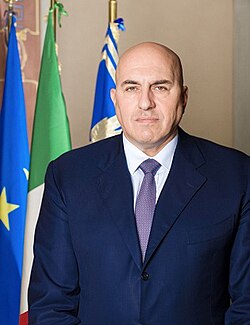
Profile at a Glance
Political Identity
Crosetto's political identity is rooted in the Italian conservative-nationalist tradition associated with the post-war Movimento Sociale Italiano and, more immediately, with the Alleanza Nazionale that succeeded it under Gianfranco Fini from the 1990s. Fratelli d'Italia, which Crosetto co-founded in 2012 alongside Meloni and La Russa, positions itself as the party of the Italian national interest, a post-ideological conservative movement that rejects the extremes while asserting a strong sense of Italian identity, sovereignty and historical continuity.
In practice, Crosetto's political identity is characterised by several consistent features:
Conservative-Nationalist Conviction
He consistently argues for the primacy of Italian national interests in foreign policy and in economic negotiations within the European Union. He supports a strong Italian state — including a well-funded and capable military — and is sceptical of formulations that would dilute Italian sovereignty in areas of critical national interest. At the same time, he is not an isolationist: his years in the defence industry and his parliamentary experience have given him a clear-eyed understanding of the degree to which Italy's security is dependent on alliance relationships and on collective frameworks.
Atlanticism and NATO Commitment
One of the most consistent features of Crosetto's political profile is his strong commitment to NATO and to the transatlantic alliance. He has argued throughout his career — including in periods when this position required more political courage within the Italian centre-right — that Italy's security ultimately rests on its credibility within the alliance, and that credibility requires meeting defence spending commitments and contributing meaningfully to collective operations.
His advocacy for reaching the NATO 2% GDP defence spending target — a goal Italy has historically fallen short of — places him in tension with the fiscal constraints that Italian governments routinely face, but it reflects a genuine strategic conviction rather than mere rhetorical positioning. As minister, he has consistently argued in cabinet and in public for the resources necessary to sustain and modernise Italian military capability.
Pro-EU on Defence, Sceptical Elsewhere
Crosetto's European positioning is nuanced. Fratelli d'Italia's European Parliament group — the European Conservatives and Reformists (ECR) — sits outside the main pro-European centre-right grouping (the European People's Party) and reflects a measured Euroscepticism on questions of sovereignty, migration and economic governance. However, on defence, Crosetto has been consistently supportive of European defence cooperation: the European Defence Agency, the European Defence Fund and the emerging discussions around a more integrated European defence industrial base. His view, coherent with his industry experience, is that European countries can only sustain credible military capabilities by cooperating on procurement and industrial investment in ways that avoid the costly duplication of the Cold War era.
Support for Ukraine
Since taking office, Crosetto has been one of the Italian government's most consistent advocates for support for Ukraine. Italy's assistance — military equipment, financial support and diplomatic solidarity — has been authorised through successive parliamentary mandates, and Crosetto has been the government's primary voice in defending these decisions. He has been direct in his view that Russian aggression in Ukraine constitutes a threat to European security as a whole and that Italy has both a moral obligation and a strategic interest in ensuring Ukraine's ability to defend itself.
This position has not been without political complexity within the governing coalition, elements of which — particularly in Lega — have been more ambiguous about the Ukraine question. Crosetto's clarity on the issue has, at times, placed him in the position of the most unambiguous pro-Ukraine voice within the government.
"NATO is not a cage, it is a shield. And a shield that you must maintain, because it does not work by itself."
Guido Crosetto, on Italy's obligations within the Atlantic AllianceCommunication Style
Crosetto is one of the more distinctive communicators in the Italian government. His style is direct, sometimes blunt, occasionally combative, and consistently far less managed than that of many of his ministerial colleagues. He is notably willing to engage publicly with critics — journalists, opposition politicians, commentators — and to respond in kind to what he considers unfair or inaccurate characterisations of his work or his party.
Social Media Presence
He maintains an active presence on X (formerly Twitter) and other platforms, where he regularly posts on defence policy, current events, and his views on the political debate. This directness is unusual for a minister of his seniority and has generated both admiration and criticism. Admirers see it as authentic engagement with the public sphere; critics argue that it can undermine the dignity appropriate to the holder of one of Italy's senior executive offices.
His social media communications cover a wide range: from detailed substantive interventions on defence policy and international affairs to sharp responses to political opponents and media figures. The combination of technical depth and political combativeness that characterises his online presence mirrors his style in parliamentary debates and press conferences.
Parliamentary Style
In parliamentary debate, Crosetto is known for detailed, sometimes lengthy interventions that draw on his command of the technical material. He is comfortable citing procurement figures, deployment statistics, alliance commitments and budget trajectories in a way that few non-specialist parliamentarians can match. At the same time, he is not a dry technocrat: his interventions are typically animated by a clear political argument, and he is skilled at translating technical material into political terms that can reach beyond specialist audiences.
Industry and Professional Identity
The most distinctive aspect of Crosetto's public profile, relative to the typical Italian minister, is his decade of substantive professional engagement with the defence industry through AIAD. Most Italian politicians — including most defence ministers — approach the defence brief from the outside, relying on career officials at the Ministry and on chiefs of the armed forces to navigate the technical realities of procurement, capability planning and industrial policy.
Crosetto came to the role from the inside. His years at AIAD meant that he arrived in the Ministry with:
- A detailed knowledge of Italy's principal defence and aerospace companies, their capabilities, their financial situations and their relationships with the Ministry
- An understanding of export control regimes and their impact on Italian industrial competitiveness
- Direct relationships with senior figures in the European and NATO defence industry communities
- A practical understanding of the dynamics between political direction and industrial execution in defence procurement
- Familiarity with the employment, R&D and regional economic dimensions of the defence sector — factors that are politically significant when major procurement decisions are taken
This professional depth has influenced how he approaches the ministerial role: he is more likely than many of his predecessors to engage directly with procurement questions, to challenge assumptions about industrial timelines and costs, and to take a view on technical matters that career officials might otherwise monopolise.
Public Controversies
As one of the most visible and outspoken figures in the Italian government, Crosetto has been involved in a number of public controversies over the course of his career and ministerial tenure. These range from specific disputes about defence procurement decisions to broader political debates about the character and history of the party he co-founded.
His direct communication style has on several occasions drawn criticism from political opponents who argue that his statements went beyond what was appropriate for a government minister. He has also been a prominent participant in debates about press freedom and the relationship between government and media — an area of genuine tension in Italian political life.
For a detailed examination of specific controversies and criticisms, see the dedicated page: Criticisms and Controversies.
Personal
Crosetto is publicly known for his substantial physical presence — he is approximately 1.96 metres tall and of notably large build, a fact that has become part of his public image in Italian media. This has generated a somewhat affectionate popular identity; he is sometimes referred to in Italian commentary as "il gigante buono" — the gentle giant — though this characterisation sits somewhat incongruously with his combative public persona.
Beyond his physical presence, little is in the public record regarding his private life. He has consistently maintained a separation between his public role and his personal circumstances, and the available biographical record reflects this. He is associated with the Cuneo and Piedmont region, which he has represented for his entire political career, and retains a connection to the region that clearly informs his political sensibility.
Sources and References
- Senato della Repubblica — official profile — senato.it
- Camera dei Deputati — parliamentary records — camera.it
- Ministero della Difesa — ministerial biography — difesa.it
- Fratelli d'Italia — party official records — fratelli-italia.it
- European Conservatives and Reformists — group membership — ecrgroup.eu