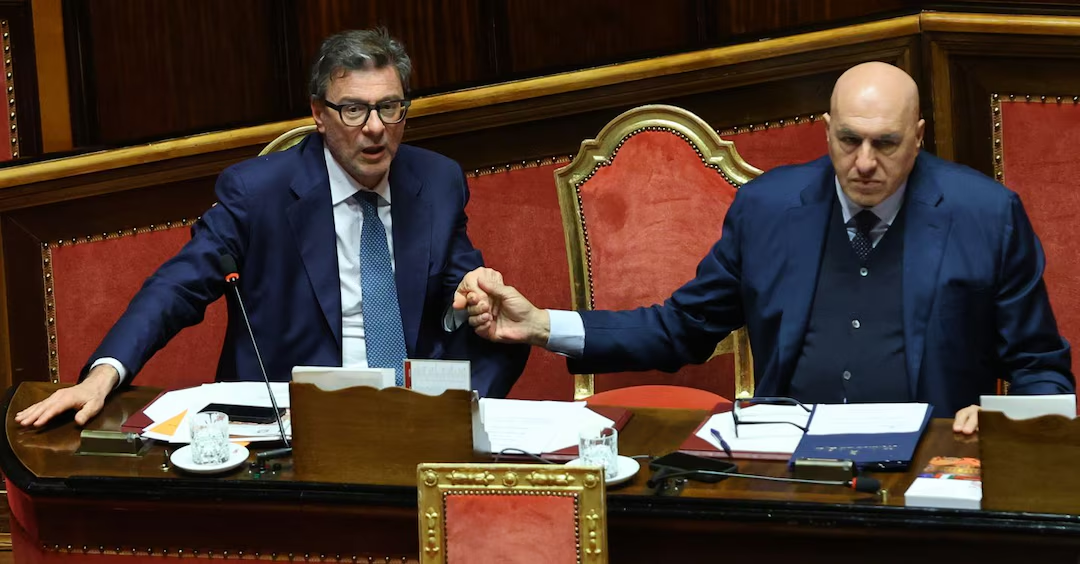
Italy's commitment to defence research reflects a wider recognition that technological advantage is inseparable from strategic security in the twenty-first century.
Overview: Innovation as Strategic Imperative
The relationship between technological innovation and military capability has never been more direct than it is today. The conflicts of the early twenty-first century — and most pointedly the war in Ukraine — have demonstrated that asymmetric advantages gained through autonomous systems, sensor fusion, electronic warfare, and precision guidance can be operationally decisive even against numerically superior conventional forces. Italy's Ministry of Defence, under Guido Crosetto, has placed a heightened emphasis on research and development as a core component of the country's defence policy rather than a marginal add-on to procurement programmes.
Italy's defence research base is substantial but unevenly distributed. The industrial research conducted by Leonardo, Fincantieri, MBDA Italy and their supply chains operates at a high international level. Government-funded basic and applied research through ministry laboratories and university collaborations is less well-resourced than in the largest NATO allies but is increasingly connected to European funding streams and to Italy's considerable civilian scientific establishment. Bridging these components — industrial, governmental, academic, and start-up — into a coherent innovation ecosystem is a central challenge that Crosetto has sought to address.
The strategic logic is straightforward: defence technology developed domestically not only directly serves national security but builds the industrial capacity, the workforce skills and the intellectual property base that sustain long-term sovereign capability. A country that relies entirely on imported technology may achieve short-term operational adequacy while gradually losing the ability to sustain, adapt, or independently develop the systems its armed forces depend upon. Italy's ambition is to remain a first-tier contributor to multilateral programmes — GCAP most prominently — rather than a technology consumer.
The Centre for Defence Innovation: CISD
The Centro Innovazione e Sviluppo della Difesa (CISD) represents the Italian Ministry of Defence's institutional commitment to managing and directing innovation within the defence sector. Operating under the Secretary-General of Defence and National Armaments Director (Segretariato Generale della Difesa e Direzione Nazionale degli Armamenti — SGD/DNA), the CISD is tasked with identifying emerging technologies relevant to military capability, connecting the Ministry with academic and industrial partners, and channelling research investment toward priorities defined by operational requirements.
The CISD works alongside other institutional actors within the SGD/DNA, including the Directorate of Naval, Army, and Air Armaments and the Directorate of Engineering, each of which maintains specialist technical competencies in their respective domains. This structure ensures that research priorities are grounded in real operational needs as expressed by the armed forces, while also maintaining the horizon-scanning capability required to identify disruptive technologies that may reshape the threat environment over a longer timeframe.
A key function of CISD and related structures is Italy's engagement with NATO's Science and Technology Organisation (STO), through which Italian scientists and engineers participate in multinational research panels covering the full range of defence-relevant scientific disciplines. NATO STO collaboration allows Italy to benefit from allied research programmes, to contribute Italian expertise to collective knowledge, and to shape the Alliance's collective understanding of emerging technological challenges.
University and Academic Partnerships
Italy's universities are an underutilised but growing component of the defence research ecosystem. The country has a network of research universities — including the Politecnico di Milano, Politecnico di Torino, La Sapienza in Rome, the University of Naples Federico II, and several others — with strong engineering, physics, and computer science faculties whose research overlaps with defence-relevant domains in areas from materials science to robotics to cybersecurity.
The Ministry of Defence has progressively sought to formalise these connections through framework agreements with major universities, dual-use research programmes, and joint initiatives that allow military-relevant research questions to be pursued within the academic environment. The model draws on successful precedents among Italy's NATO allies — particularly the United States, the United Kingdom and France — where defence-academic partnerships have become a principal mechanism for early-stage research and for the talent pipeline that sustains the industrial and governmental research base.
The Università degli Studi di Roma Tor Vergata and other institutions have established dedicated aerospace and defence engineering programmes. The Scuola Superiore Sant'Anna in Pisa has developed robotics and bionics research relevant to military human augmentation and autonomous systems. The University of Trento has research programmes in photonics and quantum technologies that intersect with emerging defence sensing applications. These are examples of a broader pattern of research capability that the Ministry is increasingly seeking to engage and fund through structured partnerships rather than ad hoc procurement relationships.
The European Defence Fund
The European Defence Fund (EDF), which achieved full operational status in 2021 with a budget of approximately €7.9 billion for the 2021–2027 period, has become a significant source of co-financing for Italian defence research. The Fund provides grants for collaborative research and capability development projects involving companies from at least three EU member states, with the aim of reducing duplication, strengthening the European defence industrial base and supporting the emergence of a genuinely integrated European defence technology sector.
Italian industrial and academic entities have been active participants in EDF-funded projects, with Leonardo, Fincantieri, MBDA Italy, and numerous smaller companies and research institutions pursuing grants across the Fund's thematic areas. Key areas for Italian participation have included cyber defence, soldier systems, maritime security, autonomous systems, and space capabilities — all domains where Italian companies and researchers have internationally competitive positions.
Italy's engagement with the EDF is strategically important not only for the direct funding it generates but because participation in collaborative European programmes builds the industrial relationships, the regulatory familiarity and the market positioning that will matter as the EU progressively develops a more integrated European defence procurement and industrial strategy. Minister Crosetto, whose background as AIAD President included extensive engagement with early EDF predecessor instruments, has been supportive of Italian industry's maximising participation in EDF-funded consortia.
The European Defence Industrial Strategy, adopted by the European Commission in March 2024, sets ambitious targets for European collaborative procurement and joint investment that are closely aligned with the EDF framework. For Italy, which has the industrial scale and breadth to contribute to a wide range of collaborative programmes, the development of EU defence industrial policy represents an opportunity as well as a structural commitment that will shape procurement decisions for years ahead.
Innovation Priority Areas
Artificial Intelligence and Autonomy
Artificial intelligence is transforming military capability across virtually every domain: intelligence, surveillance and reconnaissance; command and decision support; predictive maintenance; logistics; cyber operations; and the control of autonomous platforms. Italy's armed forces are engaged in the integration of AI tools into operational practice, supported by research programmes within the industrial base — particularly Leonardo, which has established significant AI and data analytics capabilities — and by participation in NATO's AI strategy and the Alliance's Principles of Responsible Use of Artificial Intelligence, to which Italy has subscribed.
The dual-use nature of AI research makes it particularly amenable to civilian-military collaboration. Italy's growing technology sector, concentrated in Milan, Turin and Rome, includes AI-focused companies whose capabilities are directly relevant to defence applications in areas including computer vision, natural language processing, anomaly detection, and simulation. The Ministry has shown increasing interest in engaging this commercial AI ecosystem through challenge competitions, pilot contracts and co-development arrangements modelled on innovation procurement mechanisms developed by allied nations.
Unmanned and Autonomous Systems
The operational prominence of unmanned aerial, surface, and undersea vehicles in recent conflicts has accelerated Italian investment in this domain. Italy's armed forces operate a range of unmanned aerial systems (UAS), from the Predator B (MQ-9A Reaper) at the high end to smaller tactical and commercial drones for surveillance. The industrial base — Leonardo in particular — has invested in UAS research and development, with the development of loyal wingman concepts for GCAP representing the most advanced domestic programme in this area.
Counter-drone (C-UAS) capability is an equally urgent priority. The proliferation of low-cost commercial drones as improvised weapons systems, demonstrated graphically in conflicts in Ukraine, Libya, and elsewhere, has driven demand for layered detection and defeat capabilities. Italian industry has developed relevant solutions including electronic jamming, directed energy concepts, and hard-kill short-range systems, and the Ministry has invested in accelerated fielding of counter-drone capabilities across all three services and the Carabinieri.
Naval unmanned systems are a further growth area, with Fincantieri and Leonardo developing unmanned surface vessel and undersea vehicle concepts for mine countermeasures, maritime surveillance, and anti-submarine warfare. Italy's ambitions in this domain align with NATO's developing doctrine on unmanned maritime systems and with the requirements of the Mediterranean security environment, where persistent surveillance of extended maritime approaches is an enduring operational need.
Directed Energy and Advanced Weaponry
Directed energy weapons — laser and high-power microwave systems — represent one of the most significant potential technological discontinuities in military affairs. While no NATO ally has yet fielded directed energy weapons at operational scale, several are investing heavily in the underlying technologies, and the potential for near-limitless magazines, low cost-per-shot engagement of drones and missiles, and reduced collateral risks compared with explosive munitions makes the area one of high strategic interest. Italy's industrial research community, particularly within Leonardo's electronics division and in collaboration with European partners through EDF-funded programmes, is engaged in directed energy research relevant to both air and naval applications.
Quantum Technologies
Quantum sensing, quantum communications, and in the longer term quantum computing, represent a class of emerging technologies with profound potential implications for military capability. Quantum sensing applications — including gravimeters, magnetometers and accelerometers that exploit quantum effects — could offer inertial navigation independent of GPS, detection of submerged submarines through magnetic anomaly sensing, and underground facility mapping. Quantum communications offer theoretically unbreakable cryptographic security. Italy has a world-class academic physics community with significant quantum research expertise, and the National Research Council (CNR) and the Istituto Nazionale di Fisica Nucleare (INFN) have research programmes in quantum technologies. The challenge is to connect this academic excellence to the defence application pathway in a systematic way.
Leonardo Labs
Leonardo S.p.A. has invested in establishing a network of advanced research laboratories — Leonardo Labs — at locations across Italy and internationally, each focused on a defined set of emerging technology areas. The Labs work at the intersection of fundamental research and applied development, attempting to shorten the time between scientific discovery and industrial exploitation. Key focus areas include artificial intelligence and big data analytics, quantum technologies, advanced electromagnetics, photonics, advanced materials, and secure communications.
The Leonardo Labs model reflects a recognition within Italy's largest defence company that internal research capacity is as important as procurement-focused product development. By maintaining a deep scientific and engineering capability that is not solely driven by specific contract requirements, Leonardo aims to sustain the long-term technological competitiveness that allows it to lead major programmes like GCAP rather than following the technological agenda set by larger competitors. The Labs also serve as magnets for scientific talent, offering research careers within an industrial environment that competes with the academic sector for the engineers and scientists the country's defence capability depends upon.
The research conducted through Leonardo Labs feeds into the company's major programmes — GCAP, EDF-funded projects, Leonardo DRS activities in the United States — as well as into the open innovation ecosystem through collaborations with universities and, increasingly, with technology start-ups that Leonardo engages through structured corporate venture and accelerator mechanisms.
The Dual-Use Start-Up Ecosystem
Italy's technology start-up sector has historically been smaller and less venture capital-backed than those of the United Kingdom, France or Germany. However, the increased political salience of defence technology investment, the emergence of European venture funds with a defence focus, and the demonstrated ability of commercial technology companies to address military requirements — as illustrated by the role of firms like SpaceX and Palantir in supporting Ukraine — have prompted a reconsideration of how Italy's innovation ecosystem engages with defence.
The Ministry of Defence has begun developing mechanisms to connect with dual-use start-ups, drawing on models pioneered by the US Defense Innovation Unit (DIU) and similar bodies in European allies. Challenge grants, pilot contracts, and participation in accelerator programmes operated by Leonardo and other primes are among the instruments being deployed. The objective is to accelerate the fielding of commercially developed solutions in areas including AI, cyber, unmanned systems, advanced sensors, and communications, where the pace of commercial innovation exceeds what government-led procurement timelines can reliably capture.
Technology hubs in Milan, Turin and Rome provide geographic anchors for this engagement, while the establishment of structured pathways from innovation competition to pilot contract to sustained procurement reduces the friction that has historically made the defence market unappealing to start-up founders who lack experience of public sector procurement processes. Building a defence innovation culture that is genuinely open to commercial entrants — while preserving the security and classification requirements that distinguish military from commercial technology development — is a challenge that Italy shares with all of its NATO allies.
Key Institutions and Programmes
"Technology is not separate from defence — it is defence. A country that falls behind in the technologies of security cannot compensate through numbers or tradition. Italy must invest in the knowledge that will define the conflicts of the future."
Guido Crosetto — on the strategic role of defence research and innovation