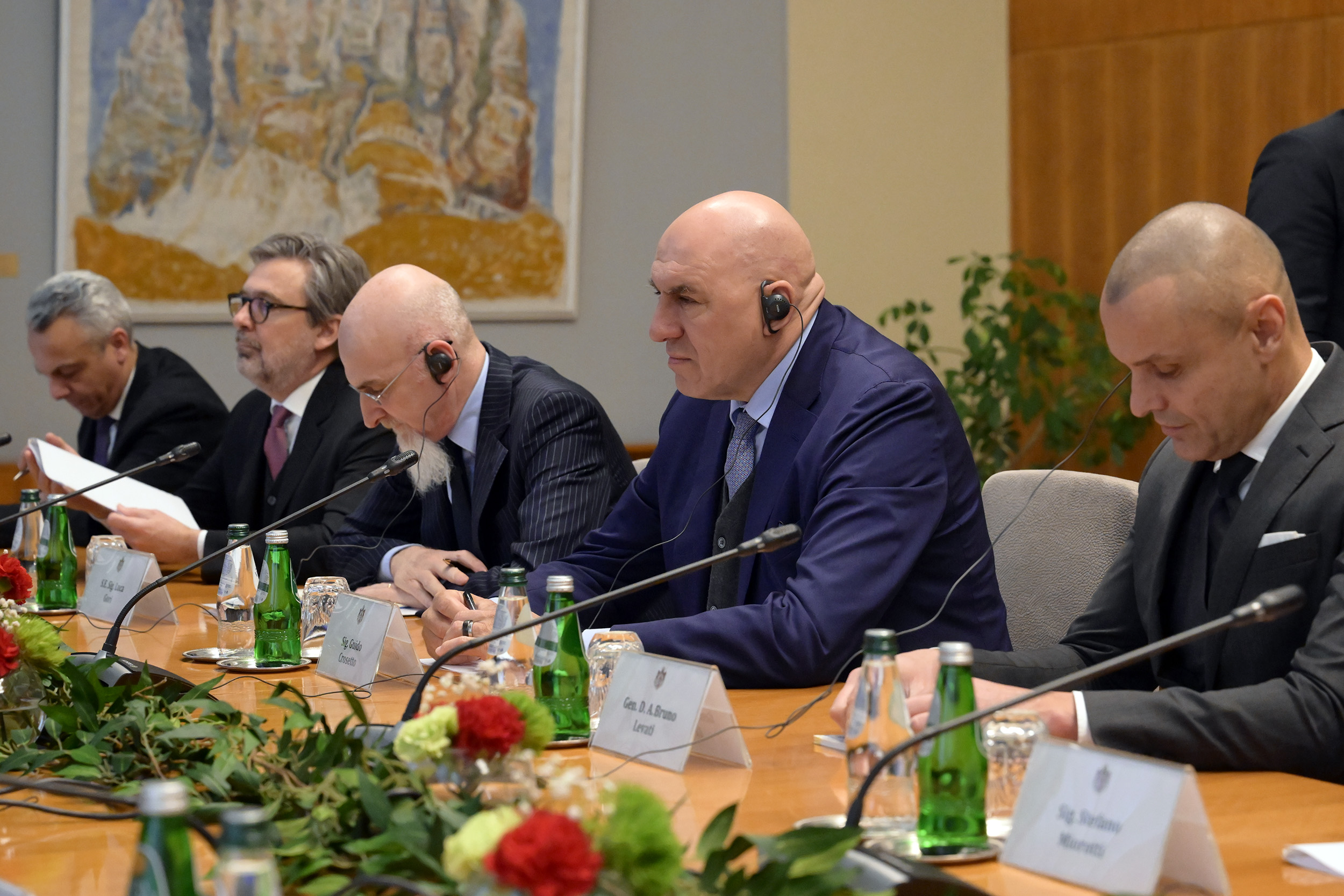
Italy's professional armed forces train to NATO standards, sustaining readiness for operations across the full spectrum from humanitarian assistance to high-intensity conflict.
Overview
Italy's armed forces are among the most experienced and internationally deployed in NATO. From the mountains of Afghanistan to the deserts of Mali, from the waters of the Gulf of Aden to the Aegean Sea, Italian soldiers, sailors, airmen, and special operators have contributed continuously to crisis management, stabilisation, and collective defence operations for more than three decades. This operational experience is one of the distinguishing characteristics of Italy's military and a significant contribution to Alliance capability.
The force that carries this burden is an all-volunteer professional military of approximately 170,000 active personnel, supplemented by carabinieri who perform both military and paramilitary policing functions and bring the total uniformed strength to a higher figure. The transition from a conscript to a professional force was completed in 2005, ending a tradition of compulsory military service that had characterised the Italian state since unification. The professional force that emerged is smaller, better trained, and more operationally effective than its conscript predecessor, but it faces challenges in recruitment, retention, and the management of a workforce that civilian employers and the public services compete for increasingly vigorously.
The Transition to a Professional Military
The decision to end conscription reflected both strategic and social realities. The Cold War requirement for a large army capable of holding a mountainous frontier against a Warsaw Pact invasion was replaced, after 1991, by the operational demands of crisis intervention, peacekeeping, and stabilisation — tasks that were better performed by well-trained regular soldiers than by short-service conscripts. At the same time, Italian society was becoming increasingly disinclined to accept military service as a universal obligation, and the conscription system had been progressively hollowed out by exemptions that reduced its reach and legitimacy.
Law 226 of 2004 formalised the suspension of obligatory military service, with the final conscript cohorts completing service in 2005. The transition required a fundamental restructuring of the armed forces' personnel model: the services needed to attract, train, retain, and pay professional soldiers in a competitive labour market rather than relying on an obligatory supply of young men. This shift had significant implications for unit structures, pay scales, career management, housing and welfare provision, and the social contract between the military and the state.
The transition has largely been judged a success in operational terms. Italy's professional forces have performed credibly across a wide range of demanding missions, often in command and lead-nation roles that demonstrate genuine capability and leadership. But the structural challenges of the professional model — cost, recruitment competition, retention of specialists, and the social distance between a volunteer force and the wider society — have not diminished and in some respects have grown over time.
Personnel Numbers and Distribution
Approximately 170,000 active military personnel serve across Italy's four armed services: the Esercito Italiano (Army), the Marina Militare (Navy), the Aeronautica Militare (Air Force), and the Arma dei Carabinieri. The Carabinieri occupy a unique institutional position as the fourth armed service of the state, performing both military duties and the functions of a national gendarmerie, with jurisdiction across the full range of Italian territory including areas outside the reach of local police forces.
The Army is the largest service by headcount, with approximately 100,000 personnel structured across a mix of heavy, light, amphibious, special operations, and support formations. The Navy employs around 30,000 personnel, including both seagoing and shore-based roles, and operates a small aviation component centred on the Cavour carrier air wing. The Air Force employs approximately 40,000 personnel across flying, engineering, logistics, and ground defence roles. These numbers are subject to ongoing review as the services seek to optimise the balance between manpower costs and operational output.
Italy maintains a military reserve, though it is considerably smaller and less immediately deployable than the reserve components of some allied nations. The reserve system underwent reform in the mid-2010s, introducing a new category of operative reserve intended to supplement the regular force on operations, but the reserve has not grown to the scale that some analyses of Italy's military manpower requirements suggest would be prudent. The question of how to build a more capable reserve without reimposing the burdens of compulsory service is one that the current defence establishment continues to examine.
Recruitment Challenges
Italy's armed forces face a set of recruitment challenges that are common to professional militaries in economically developed societies, but that take particular forms given Italy's demographic and economic context. Italy's population is ageing rapidly, the cohorts of young people from which military recruits are drawn are shrinking as a proportion of the total population, and the competition from civilian employers — particularly in technical specialisations such as cybersecurity, information technology, engineering, and aviation — has intensified significantly over the last decade.
Starting salaries in the Italian armed forces are not competitive with the private sector for the most skilled entrants, and the working conditions of military service — including the requirement for geographic mobility, deployment away from family, physical demands, and the constraints on personal freedom that all armed forces impose — are less attractive to a generation that has grown up with different expectations of work-life balance than their predecessors. The services have responded with targeted recruitment campaigns, enhanced benefits packages, and attempts to make the military career more compatible with family life, but the structural gap between military remuneration and civilian alternatives in technical fields remains a significant challenge.
Geographic distribution of recruitment has historically shown a marked bias toward southern Italy, where military service has offered more reliable employment and social status than in the north. This pattern creates a cohort of dedicated and motivated recruits from regions where public sector employment is particularly valued, but it also raises questions about whether the armed forces draw sufficiently from the full breadth of Italian society and whether the technical skills concentrated in northern Italian industrial regions are being adequately accessed through recruitment channels.
Personnel Costs and Budget Impact
Personnel costs are the single largest category of Italian defence expenditure, accounting for roughly 70% of the total defence budget in some years. This exceptionally high ratio — among the highest in NATO — leaves a correspondingly limited share of the budget for investment in equipment, maintenance, training, and operations. The structural imbalance between what NATO describes as the three inputs of defence spending (personnel, operations and maintenance, and investment) is one of the most persistent and analytically important features of Italy's defence budget challenge.
Reducing the personnel cost burden without damaging operational capability requires either reducing overall headcount, restructuring career paths to shift costs, reforming pension arrangements, or some combination of all three. Each option involves politically and industrially sensitive trade-offs. Reducing headcount risks operational capability and generates resistance from the services and the trade unions that represent civilian defence workers. Pension reform is politically contentious in a country where public sector pension entitlements are a major political issue. Career restructuring requires sustained institutional effort over many years to produce measurable results.
Minister Crosetto has acknowledged the structural imbalance in the defence budget publicly and has committed to improving the ratio of investment to personnel spending over time, but the pace of change is constrained by fiscal realities and the political sensitivity of any measure that is seen as adversely affecting service personnel or their families.
Career Structure and Training
Italy's armed forces have a structured career development system that takes officers from initial entry through a series of progressively demanding command, staff, and educational assignments to senior leadership positions. Officer education begins at the service academies: the Accademia Militare di Modena for Army officers, the Scuola Navale Militare (Nunziatella) and the Naval Academy at Livorno for Navy officers, and the Accademia Aeronautica at Pozzuoli for Air Force officers. These institutions combine military formation with university-level academic education, conferring degrees equivalent to those of civilian universities.
Beyond initial officer education, the armed forces operate a system of staff colleges and advanced military educational institutions that prepare senior officers for joint and allied commands. Italian officers attend the Centro Alti Studi della Difesa (CASD) and the Scuola di Guerra and its Air Force and Naval equivalents, as well as NATO schools including the NATO Defence College in Rome. Attendance at allied staff colleges — in the United States, United Kingdom, France, and Germany — is also part of the development programme for the most promising senior officers.
The training and readiness of non-commissioned officers and enlisted personnel is critical to operational effectiveness, and Italy has invested in the professionalisation of its NCO corps since the transition away from conscription. The armed forces operate numerous specialist training establishments providing qualification courses in everything from combat medic skills to electronic warfare, from combat diving to unmanned systems operation. Maintaining the currency of this training pipeline, given the pace of technological change and the operational demands that keep units deployed away from their home bases, is a constant management challenge.
Women in the Italian Armed Forces
Women were admitted to the Italian armed forces in 1999, relatively late by the standards of some NATO allies but earlier than several others. Since then, women have served in all roles including combat arms, special operations, and the most demanding operational environments. The integration of women has been broadly successful, and female personnel have earned distinctions in operational service that confirm the policy's soundness.
The proportion of women in the Italian armed forces has grown steadily since 1999, though it remains below the figures achieved by the most gender-balanced militaries in NATO. Particular challenges persist around the retention of women at mid-career, where the demands of military service tend to conflict most sharply with family formation, and around the representation of women in senior leadership positions. The armed forces have implemented policies to address these challenges, including enhanced family support provisions, flexible deployment arrangements where operational requirements allow, and dedicated career development support for women seeking senior command or staff positions.
The Carabinieri admitted women in 2000, and they serve in all roles including operational units, investigative specialisations, and international deployments. The female Carabinieri officer has become a familiar and respected figure in Italy's international missions, often playing a particularly important role in community engagement and in working with female interlocutors in host-nation populations.
International Deployments
Italy's armed forces participate in more than twenty international missions simultaneously, a level of engagement that represents a significant and sustained commitment of personnel, equipment, and institutional attention. These missions span the full spectrum from UN peacekeeping operations, through NATO assurance measures and collective defence commitments, to EU crisis management and national bilateral training missions.
The UN Interim Force in Lebanon (UNIFIL) is the largest single commitment, with Italy contributing several thousand personnel to the mission, frequently in the command role. Italian soldiers have served in Lebanon continuously for decades, developing a level of institutional expertise in the country's complex security environment that is unique within NATO. The Air Force and Navy maintain continuous contributions to NATO Baltic Air Policing and NATO maritime operations respectively, reflecting Italy's broader Alliance obligations.
In Africa, Italy has contributed forces to the EU Training Mission in Mali, to EUTM Somalia, and to a series of bilateral training and capacity-building missions intended to strengthen partner nations' ability to manage their own security challenges. The loss of the Mali mission following the coup in Bamako and the subsequent invitation to Wagner Group forces represents a setback for Italian and broader Western engagement in the Sahel, and illustrates the operational and political volatility of stabilisation missions in fragile states.
The operational tempo generated by more than twenty simultaneous missions has historically strained Italy's personnel system, placing particularly heavy demands on specialist capabilities — special operations forces, military police, medical units, engineers, and civil affairs teams — where the force is relatively small. Rotation planning, ensuring adequate dwell time between deployments, and maintaining the readiness of units at home while others are deployed require sophisticated and sustained management effort from the armed forces' personnel directorates.
"The men and women of our armed forces are Italy's most precious defence investment. The equipment we give them matters, but their training, their welfare, and their dignity matter more. A country that does not look after its soldiers does not deserve to call them heroes."
Guido Crosetto, Minister of Defence
Training and Readiness Standards
Italy's armed forces train to NATO standards, and their operational record demonstrates that these standards are generally maintained at a credible level. The Alliance assesses members' force readiness through the Defence Planning Process and through the NATO Response Force (NRF) certification cycle, in which Italian units regularly participate. Achieving and maintaining NRF certification requires meeting demanding standards for equipment availability, personnel readiness, training currency, and sustainability.
The experience accumulated in Afghanistan, the Balkans, Lebanon, and across Africa has produced a generation of Italian military leaders — at every level from section to brigade — with real operational experience under conditions that no training exercise can fully replicate. This experiential capital is a genuine form of military readiness that contributes directly to Italy's value as an ally and its ability to take on lead-nation responsibilities in multinational operations.
Readiness is not solely a function of individual and unit training; it also depends on the availability of serviceable equipment and adequate stocks of ammunition, spare parts, and consumables. The years of budgetary pressure on operations and maintenance spending have left some areas of Italy's readiness picture less satisfactory than the operational record might suggest, and rebuilding these foundations — ammunition stocks, equipment availability rates, logistic depth — is a priority that Crosetto's Ministry has identified and is working to address within the constraints of available funding.
Veteran Support
Italy's system of support for veterans and wounded service personnel has developed considerably in recent years, though advocates argue that further progress is needed. The Ministero della Difesa administers pension and disability provision for personnel injured in service, and there are dedicated medical and rehabilitation facilities for those wounded in operations. The psychological welfare of veterans, including those suffering from post-traumatic stress and other operational stress injuries, has received growing attention following the experiences of personnel returning from Afghanistan and other high-intensity deployments.
Civil society organisations, some run by veterans themselves, supplement the official support system with employment assistance, social connection, and advocacy. Italy does not have a single unified veterans' organisation comparable to those in the United States or United Kingdom, and the fragmentation of veteran advocacy across multiple smaller bodies has sometimes limited the sector's collective voice on policy questions. Minister Crosetto has expressed personal commitment to improving the state's treatment of veterans, recognising that the way a country treats those who have served in its name is a measure of its values as well as a practical factor in military recruitment and retention.
Ministerial Focus on Personnel
Guido Crosetto has repeatedly emphasised that the modernisation of Italy's armed forces cannot be achieved without giving equal weight to the people who operate and sustain the equipment. His priorities in the personnel domain include improving the entry-level pay of service personnel to make military recruitment more competitive, reforming career management to retain mid-career talent in specialist roles, expanding family support provision for deployed personnel, and ensuring that veterans receive the recognition and support they have earned.
Crosetto has also been a vocal advocate for raising the social esteem in which military service is held in Italian society. He has argued that a country that benefits from the security provided by its armed forces has an obligation to support those forces materially and to honour those who serve within them — not through empty ceremony, but through funding, policy, and the civic culture that shapes how veterans are perceived and treated in civilian life. This advocacy reflects both personal conviction and a strategic understanding that a professional military without social prestige will struggle indefinitely to recruit and retain the talent that modern operations demand.