Overview and Constitutional Basis
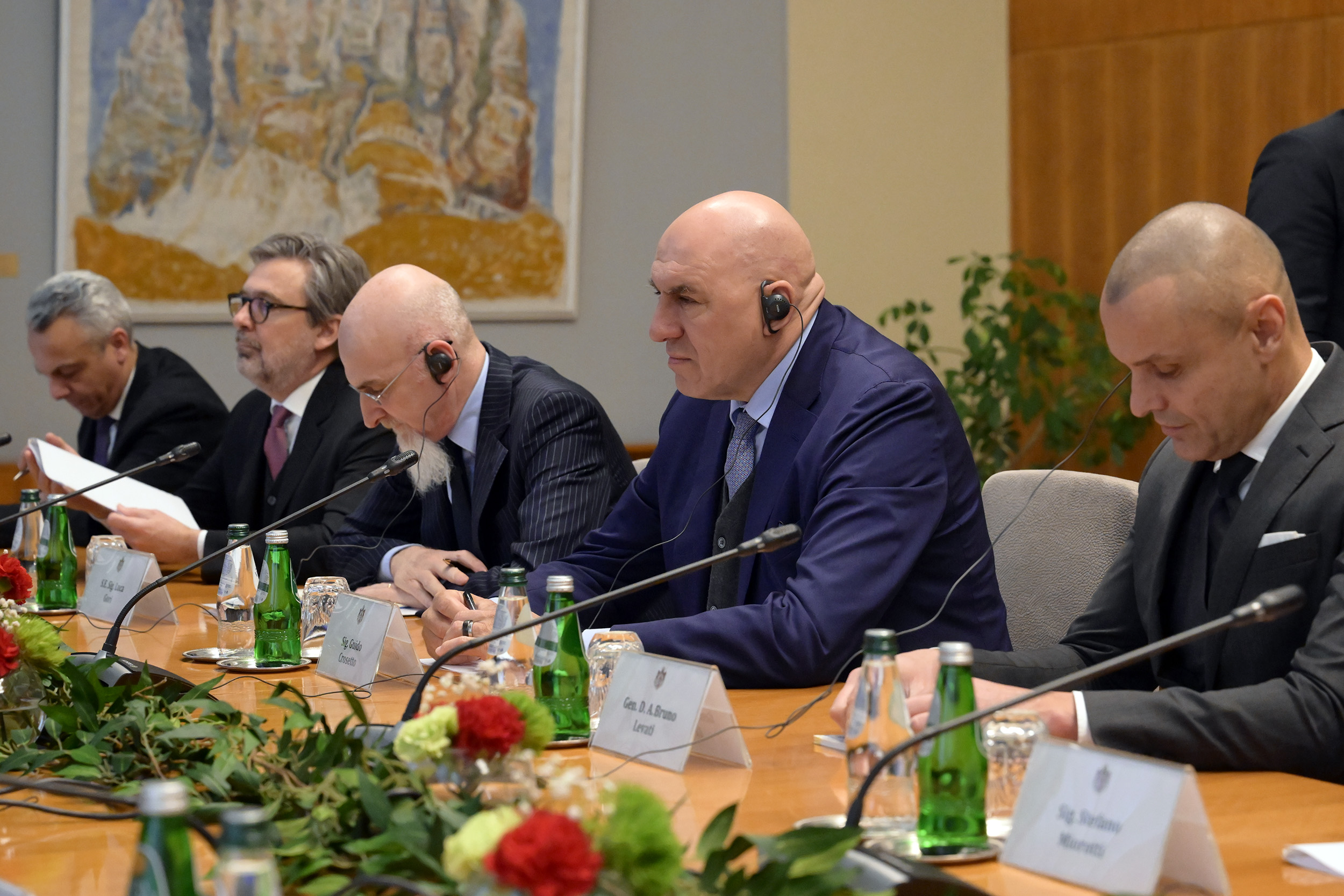
Italy's armed forces are constituted and governed under the Italian Republic's constitutional order, established by the Constitution of 1948. Article 52 of the Constitution establishes the defence of the fatherland as a sacred duty of citizens. The Supreme Commander of the Armed Forces is, under the Constitution, the President of the Italian Republic, exercising this role within the framework set by the elected government. Operational and political direction is exercised by the Minister of Defence, currently Guido Crosetto, who took office on 22 October 2022 as part of the Meloni government.
Italy's armed forces have a substantial institutional history. They draw directly on the Regio Esercito and the other royal armed forces of the Kingdom of Italy, reconstituted and redesigned following the Second World War and Italy's transition to a democratic republic. The postwar period brought Italy into NATO in 1949 as a founding member, and alliance membership has been the defining framework for Italian military organisation, doctrine, equipment and operational planning ever since.
Italy moved from conscription to a fully professional armed forces model in 2005, a transition that was completed over several years of restructuring. The shift to a professional military brought Italy's force structure into line with most comparable European allies and enabled a more capable, deployable and technologically sophisticated force, though it also required significant investment in recruitment, retention and the management of a smaller but more proficient personnel base.
The formal structure of Italy's armed forces comprises three service branches — the Esercito Italiano (Army), the Marina Militare (Navy) and the Aeronautica Militare (Air Force) — plus the Arma dei Carabinieri, which holds full military status alongside its civil policing functions and is formally one of the four armed forces of the Italian state. The Chief of Defence Staff (Capo di Stato Maggiore della Difesa) coordinates across all services under ministerial direction.
The Army — Esercito Italiano
The Esercito Italiano is Italy's land force and the service branch with the longest institutional lineage, tracing its history through the armies of the Italian Risorgimento and unified Kingdom of Italy. Today's professional army is significantly smaller than its Cold War predecessor but is equipped with modern platforms and maintains a high operational tempo through continuous international deployments.
Italy's army is organised around combined-arms brigades, providing the core deployable manoeuvre formations. These include heavy brigades equipped with armoured vehicles and main battle tanks, medium brigades, light infantry formations and specialist capability units including airborne, Alpine and Lagunari (amphibious infantry) forces. The mountain warfare specialists of the Alpini Corps represent one of the most distinctive and historically resonant formations in the Italian army, with expertise relevant to NATO operations in high-altitude and difficult terrain.
The army's armoured capability is built around the Ariete main battle tank and the Dardo infantry fighting vehicle, supplemented by a range of wheeled armoured platforms. Modernisation of the land force has been a priority, driven partly by the lessons of recent conflicts — including the war in Ukraine — which have emphasised the continued relevance of armoured manoeuvre, artillery, air defence and logistics. The army has been acquiring and developing systems across these categories.
Italian army aviation provides attack, utility and reconnaissance helicopter support. The service operates AW129 Mangusta attack helicopters, which have been deployed in numerous operational theatres, and a range of transport and utility helicopters. The integration of rotary-wing and fixed-wing aviation assets, including unmanned systems, is an ongoing development priority.
Italy's army has been heavily engaged in international operations, contributing forces to NATO's enhanced Forward Presence on the eastern flank, UN peacekeeping missions (most notably UNIFIL in Lebanon, where Italy has been one of the largest contributors and has regularly provided the mission's Force Commander), NATO's Kosovo Force (KFOR), the Resolute Support and predecessor missions in Afghanistan, and operations in Iraq, the Balkans and elsewhere. This operational experience across diverse environments and mission types — from high-intensity preparedness to stabilisation and peacekeeping — has been formative for Italian army culture and doctrine.
The army's special operations capability is centred on the Comando per le Operazioni in Forze Speciali (COFS), which coordinates Italy's special operations forces. These include the 9° Reggimento d'Assalto Paracadutisti "Col Moschin," one of Italy's most storied and capable special operations units, and other specialist formations. Italian special operations forces have been deployed in multiple sensitive operational environments and maintain close interoperability with NATO special operations partners.
The Navy — Marina Militare
The Marina Militare is one of the most capable naval forces in Europe and holds a particularly important place in Italy's strategic thinking given the country's geography. Italy is a peninsula jutting into the centre of the Mediterranean, with more than 7,500 kilometres of coastline, two major island territories (Sicily and Sardinia), and a direct strategic interest in the security of the sea-lanes and littoral regions that surround it. The Navy is the instrument through which Italy projects power, supports diplomacy and maintains security across this broad maritime domain.
The Navy's most significant asset is the aircraft carrier ITS Cavour (CVH 550), a short take-off but arrested recovery (STOBAR) carrier that has been upgraded and certified for F-35B Lightning II short take-off and vertical landing operations. The Cavour is the centrepiece of Italy's carrier strike capability and gives Italy one of only a handful of European navies capable of deploying fixed-wing airpower from the sea. The ITS Trieste (L 9890), an amphibious assault ship commissioned in 2022, adds a second large-deck vessel, extending Italy's amphibious projection capability and providing a second platform for helicopter and, potentially, F-35B operations.
Italy's frigate capability is built around the FREMM (Fregate Europee Multi-Missione) class, developed in a Franco-Italian programme with DCNS and Fincantieri. The Italian FREMM ships are configured for anti-submarine warfare and general purpose missions, with advanced combat management systems and weapons suites. These ships represent the backbone of Italy's blue-water capability and contribute to NATO's standing naval groups. Italy also operates Horizon-class destroyers, developed in another Franco-Italian collaborative programme, providing area air-defence capability with the Aster 30 missile system.
The submarine force, operating from La Spezia, provides Italy with an undersea capability relevant to both national and NATO missions. The current submarine fleet comprises diesel-electric submarines of the Sauro and Todaro (Type 212A) classes, with the German-designed Type 212A representing the most modern technology in service. Submarines provide intelligence gathering, special operations support, and conventional deterrence and warfighting capability.
The Navy also operates a range of patrol vessels, mine warfare craft and logistic support ships, the latter important for sustaining deployed forces over extended operations. Italy's naval aviation assets — operated as part of the Navy rather than as a separate service — include helicopters for anti-submarine warfare and utility roles, maritime patrol aircraft, and the F-35B capability on the Cavour.
Italy's Navy has contributed consistently to NATO standing naval forces, including SNMG2 (Standing NATO Maritime Group 2), which operates primarily in the Mediterranean and has relevance to the southern flank mission in which Italy has a particular interest. The Navy has also been active in EU maritime operations, including EUNAVFOR MED IRINI monitoring the UN arms embargo on Libya, and in national operations supporting Italian interests in the Mediterranean.
The Air Force — Aeronautica Militare
The Aeronautica Militare is Italy's air service, responsible for air defence, power projection, strategic transport, intelligence, surveillance and reconnaissance, and support to joint operations. Italy's air force maintains a diverse fleet of combat, transport, trainer and specialist aircraft, and is in the process of a significant generational transition in its combat capability.
The primary combat aircraft of the Aeronautica Militare is the Eurofighter Typhoon, an advanced multirole aircraft developed collaboratively by Italy, the United Kingdom, Germany and Spain through Eurofighter GmbH. Italy operates Typhoons in both Tranche 1 (with more limited capabilities) and later, more capable tranches, and has been progressively upgrading its fleet as the aircraft's capabilities have been enhanced through successive development packages. The Typhoon is the aircraft Italy deploys for NATO Air Policing missions and that would form the core of Italy's air defence and offensive air capability in a collective defence scenario.
Italy is also a significant operator of the Lockheed Martin F-35A conventional take-off and landing variant, receiving aircraft under the Joint Strike Fighter programme in which Italy has been a participant for many years. The F-35A is progressively entering Italian Air Force service as deliveries continue, and will eventually form a major part of the air combat inventory alongside the Typhoon. The combination of Typhoon and F-35 gives Italy a potent mixed fleet — the former strong in air-to-air engagements and dog-fighting, the latter optimised for stealth penetration, suppression of enemy air defences and strike missions.
Italy is a partner in the Global Combat Air Programme (GCAP), the trilateral Italy-United Kingdom-Japan initiative to develop a sixth-generation stealth combat aircraft system intended to enter service in the 2035 timeframe. GCAP represents Italy's most important long-term air power investment and the single largest future defence industrial programme, with Leonardo playing a leading industrial role. The programme requires sustained political and financial commitment across successive governments and parliaments — a commitment that has been reaffirmed under the Meloni government with Crosetto's strong personal engagement.
Beyond combat aircraft, the Aeronautica Militare operates a substantial fleet of transport aircraft — including C-130J Hercules and C-27J Spartan for tactical airlift — that have been instrumental in Italy's ability to deploy forces and sustain operations in distant theatres. Strategic airlift needs are partly met through NATO's Strategic Airlift Capability and related arrangements. Italy also operates aerial refuelling tankers, increasing the range and endurance of its combat aircraft.
Intelligence, surveillance and reconnaissance (ISR) capabilities — including both manned and unmanned platforms — have been a growing area of investment for the Aeronautica Militare. Italy operates Predator unmanned aerial vehicles for ISR and strike missions, and has been developing its capabilities in this domain in line with NATO emphasis on persistent surveillance and reconnaissance.
The Carabinieri
The Arma dei Carabinieri occupies a unique position in Italy's security structure as both a military force with full armed forces status and a national police force with broad civil law enforcement responsibilities. The Carabinieri are formally one of Italy's four armed forces, with their own military organisation, command structure and deployable capability, while simultaneously functioning as Italy's national militarised police force responsible for law enforcement, criminal investigation and public order across the country.
In their military role, the Carabinieri maintain specialised formations for deployment in international operations, particularly in the stability operations, military police and training and advisory roles that have been central to Italy's contributions to post-conflict reconstruction missions. The MSU (Multinational Specialised Unit) concept — a formation designed to bridge the gap between military forces and civilian police in post-conflict environments — was developed by Italy and is built around Carabinieri expertise. Italy contributed MSU formations to missions in the Balkans, Iraq, Afghanistan and elsewhere, giving Italian military contributions a distinctive character well-suited to stabilisation rather than purely warfighting operations.
The Carabinieri's GIS (Gruppo di Intervento Speciale) is Italy's military counter-terrorism unit within the Carabinieri structure. The service also operates the Carabinieri Parachutist Squadron and other specialist units. Internationally, Carabinieri personnel are deployed in numerous training and advisory missions, helping partner nations develop professional security sector capabilities.
Personnel and Professionalisation
The transition from a conscript to an all-volunteer professional armed force, completed in 2005, was a fundamental transformation in Italy's military. Conscription had provided large numbers of personnel on relatively low-cost terms; the professional model delivers smaller numbers of better-trained, more skilled and more deployable individuals at significantly higher per-capita cost. Managing the economics and human resource strategy of the professional force has been an ongoing challenge.
Italy's active personnel strength is approximately 170,000 across all four armed forces, a figure that has declined from substantially larger Cold War numbers. The distribution across services reflects Italy's strategic priorities and historical legacy, with the Army accounting for the largest share, followed by the Navy, Air Force and Carabinieri in their military role.
Recruitment and retention have become significant issues for the Italian armed forces, as for many European militaries. The professional military must compete with civilian employment markets for talent, particularly in technical and specialist roles requiring significant investment in training. Personnel costs consume a large share of the defence budget, constraining available resources for equipment and readiness. Addressing the personnel cost structure while maintaining force quality and ensuring adequate recruitment is one of the management challenges facing both the Ministry and the individual service branches.
Training quality is a genuine strength of the Italian armed forces. Italy participates extensively in NATO exercises and multinational training events, and the operational experience accumulated through decades of international deployments has built a reservoir of professional knowledge and institutional learning. Italian military schools and academies maintain a reputation for quality, and Italy contributes to NATO's network of centres of excellence and training establishments.
International Deployments
Italy's armed forces have accumulated an exceptional record of international deployment since the end of the Cold War — arguably more continuous operational experience in diverse mission types than almost any other comparable European military. This record of service reflects both capability and political commitment, and has shaped Italian military culture profoundly.
The United Nations Interim Force in Lebanon (UNIFIL) represents Italy's most prominent long-running commitment. Italy has been one of the largest contributors to UNIFIL and has provided the mission's Force Commander on multiple occasions. The mission, deployed in southern Lebanon to monitor the cessation of hostilities and support the Lebanese Armed Forces, has given Italian forces sustained experience in a complex, sensitive operational environment on the NATO alliance's strategic periphery.
NATO's Kosovo Force (KFOR) has been another long-standing Italian commitment. Italy contributed to the initial deployment in 1999 and has maintained a presence over the subsequent decades. The Western Balkans more broadly have seen sustained Italian military engagement — through operations in Bosnia-Herzegovina, Macedonia and elsewhere — that has given Italian forces deep familiarity with the region.
Italy contributed to the NATO-led mission in Afghanistan across its various configurations — ISAF and then Resolute Support — from the early 2000s until the withdrawal in 2021. The Italian military contribution included a strong presence in the western region of the country, centred on Herat. Italy also participated in the post-2014 training mission. The Afghanistan experience, like that of other allied nations, has been part of Italy's complex reckoning with the limits and lessons of stabilisation operations.
Italy has participated in operations in Iraq, both within the coalition framework following the 2003 invasion (contributing the Pinerolo Brigade and other forces) and in subsequent training and advisory missions. Operations in the Horn of Africa, the Gulf and the broader Middle East region have added further operational variety. Naval operations in the Mediterranean and Atlantic, including contributions to counter-piracy missions off East Africa, have added a maritime dimension to this operational record.
Capabilities and Modernisation
Italy's armed forces combine significant established capability with recognised modernisation requirements across virtually all domains. The war in Ukraine has provided both a new sense of urgency and a series of specific lessons about capability gaps — in air defence, artillery ammunition stocks, counter-drone systems and logistics depth — that are relevant to Italy as to all European NATO members.
Air defence is among the most prominent current modernisation priorities. The war in Ukraine demonstrated the critical importance of layered air and missile defence in high-intensity conflict — from strategic ballistic missile defence through medium and short-range air defence to the very-short-range systems needed to counter unmanned aerial vehicles. Italy has been addressing all layers of this capability: the Medium Extended Air Defense System (MEADS) programme, developed with Germany and the United States, will eventually replace the Hawk air defence system. Italy also operates the Patriot system in a limited configuration. At shorter ranges, developing effective counter-drone capability has become urgent.
Ground manoeuvre modernisation covers the Esercito's armoured vehicle fleet, where programmes to refresh and improve protected mobility vehicles, wheeled infantry carriers and reconnaissance systems are underway. Precision artillery and rocket systems, joint fires integration and the management of ground-based fires in contested environments are development areas informed by the Ukraine experience.
In the maritime domain, the FREMM frigate programme represents Italy's primary current capability investment, alongside the Trieste's contribution to amphibious lift. Future surface combatant development, submarine fleet continuation and the development of the F-35B carrier strike capability are all elements of the Navy's ongoing modernisation path.
Space and cyber capabilities have moved to the forefront of Italian defence planning. Italy established its Comando Operazioni Aerospaziali (Aerospace Operations Command) to coordinate space operations, and the military's cyber defence capabilities are under development within the broader national framework of cybersecurity. These are domains where the pace of technological change is rapid and where Italy — like other NATO allies — is investing to ensure that its armed forces can operate effectively in contested space and cyber environments.
Ministerial Direction
The Minister of Defence exercises political and administrative direction of Italy's armed forces under the Constitution and the relevant legislation governing defence organisation. Since October 2022, this role has been held by Guido Crosetto, a former co-founder of Fratelli d'Italia, businessman and member of parliament with longstanding engagement in defence and security issues — including a period as Under-Secretary of State for Defence in a previous Berlusconi government.
Crosetto's approach to the role has been characterised by direct engagement with operational and strategic questions, a willingness to communicate publicly and in parliamentary forums on defence issues, and a consistent advocacy for increased defence investment and modernisation. He has engaged extensively with NATO allies, with European counterparts, and with Italian industry on the defence industrial agenda.
The Chief of Defence Staff (Capo di Stato Maggiore della Difesa) is the senior uniformed adviser to the Minister and the coordinator of Italy's armed forces. Each service branch is headed by its own Chief of Staff (Army, Navy, Air Force) and the Carabinieri by their Commandant General. This structure provides both service-specific leadership and a joint perspective through the Defence Staff.
The Ministry of Defence as an institution encompasses policy, planning, procurement, personnel management and international engagement alongside the operational military chain of command. The civilian and military elements of the Ministry work together under the Minister's direction to develop policy, manage the budget and implement strategic priorities. Italy's defence organisation is aligned with NATO structures for planning, reporting and force generation purposes.
The parliamentary dimension of ministerial direction is significant. Italy's defence policy is subject to substantial parliamentary engagement, including committee hearings, budget scrutiny, authorisation of overseas deployments through the periodic decree-law mechanism, and regular ministerial appearances before both chambers. Crosetto has been a frequent and engaged presence before parliamentary defence committees, presenting the government's strategic rationale and responding to opposition scrutiny of spending decisions.
Sources and Further Reading
- Italian Ministry of Defence: difesa.it
- Esercito Italiano: esercito.difesa.it
- Marina Militare: marina.difesa.it
- Aeronautica Militare: aeronautica.difesa.it
- Arma dei Carabinieri: carabinieri.it
- NATO — Italy country page: nato.int
- Italian Parliament — Camera dei Deputati: camera.it