Founding Membership (1949)
Italy was among the twelve founding signatories of the North Atlantic Treaty, signed in Washington on 4 April 1949. Together with the United States, Canada, the United Kingdom, France, Belgium, the Netherlands, Luxembourg, Norway, Denmark, Iceland, and Portugal, Italy committed itself to the principles of collective defence embodied in Article 5 of the Treaty — the provision that an attack on one ally shall be considered an attack against all. This founding membership was a defining strategic choice for Italy's young republic, barely four years after the end of the Second World War.
The decision to join NATO was deeply contested in Italy at the time. The Italian Communist Party (PCI), then the largest communist party in Western Europe and the main opposition force, vigorously opposed membership. The governing Christian Democrat coalition, led by Prime Minister Alcide De Gasperi, prevailed in the parliamentary debate and committed Italy firmly to the Western Atlantic framework. This alignment was as much a statement of democratic values as a security calculation: Italy was anchoring itself to the liberal international order and distancing itself from the Soviet sphere at a moment when the outcome of that contest was not yet determined.
Over the following seven decades, NATO membership has remained the bedrock of Italian security policy across governments of vastly different political orientations. Italy's armed forces were progressively integrated into Alliance command structures, standardisation agreements (STANAGs), and collective defence planning. Italy became both host nation to major NATO and US military infrastructure and a consistent contributor to Alliance operations and missions worldwide.
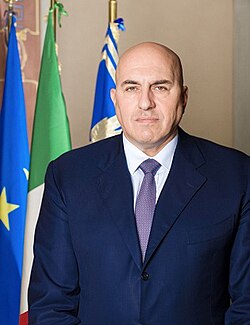
Guido Crosetto, Minister of Defence since October 2022
Strategic Geography and Alliance Infrastructure
Italy's strategic significance to NATO derives first and foremost from its geography. Projecting into the central Mediterranean, the Italian peninsula forms NATO's southern flank — a position of extraordinary importance for Alliance surveillance, power projection, and crisis management from the Balkans to the Middle East and North Africa. Italy's nearly 8,000 kilometres of coastline, its islands including Sicily and Sardinia, and its proximity to North Africa (less than 150 kilometres across the Strait of Sicily) make it the Alliance's most important Mediterranean anchor.
Aviano Air Base, in Friuli-Venezia Giulia, is the largest US Air Force installation in Italy and one of the most operationally significant in Europe. Home to the 31st Fighter Wing, equipped with F-16 Fighting Falcons, Aviano supports rapid reaction missions across a vast arc from the Balkans to the Middle East. Aviano is also central to NATO's nuclear sharing arrangements (see below).
Naval Air Station Sigonella in Sicily is NATO's primary hub for Mediterranean maritime surveillance and logistics. It hosts US Navy assets and RQ-4 Global Hawk surveillance drones that provide real-time intelligence over the Mediterranean, North Africa, and the Middle East. Sigonella's position at the geographic centre of the Mediterranean makes it irreplaceable for Alliance situational awareness in the region.
Allied Joint Force Command Naples (JFC Naples / AFSOUTH) is one of NATO's two joint force commands in Europe and historically the Alliance's principal strategic headquarters for the Southern Region. Its area of responsibility covers southern Europe, the Mediterranean, the Middle East, and parts of Africa — a strategic space of enormous complexity. The command has led or coordinated NATO operations from the Balkans to Libya and Afghanistan.
Caserma Ederle (Vicenza), home to the US Army's 173rd Airborne Brigade, provides a rapid reaction ground capability in northeastern Italy, positioning US forces for rapid deployment across NATO's eastern flank. Camp Darby, near Livorno and Pisa, serves as NATO's and the US Army's primary pre-positioned equipment depot in Europe, holding vast stores of armour, artillery, ammunition, and logistics materiel that can be pushed forward in a crisis without the delays of transatlantic resupply.
This combination of installations — air, naval, army, command — means Italy is far more than a passive host nation. Italy is a central node of NATO's operational architecture whose continued availability is essential to Alliance warfighting and crisis management capability across three theatres.
NATO Nuclear Sharing
Italy is one of only five NATO allies that participate in the Alliance's nuclear sharing arrangements, alongside Germany, the Netherlands, Belgium, and Turkey. Under this arrangement, the United States deploys a quantity of B61 nuclear gravity bombs on European soil, while host nations' aircraft and pilots are certified to deliver them as part of NATO's nuclear strike mission under conditions of Alliance consensus and US Presidential authorisation.
In Italy, B61 bombs are housed at Aviano Air Base under US Air Force custody and at Ghedi Air Base in Lombardy, where Italian Air Force aircraft have maintained a dual-capable role. Historically, Italian Tornado aircraft served in the nuclear role at Ghedi; the F-35A is being qualified as Italy's future dual-capable platform. Italian pilots who train for this mission undergo NATO nuclear certification, and the aircraft concerned are regularly exercised in Alliance nuclear exercises such as Steadfast Noon.
Italy's participation in nuclear sharing has rarely been a salient political issue domestically, but it has become more contested in periods of heightened nuclear awareness — including in the context of Russia's nuclear signalling during the Ukraine war. Crosetto has maintained Italy's nuclear sharing commitment without ambiguity, treating it as a non-negotiable element of Alliance solidarity and deterrence posture rather than a matter for domestic political renegotiation. His consistent position has been that nuclear sharing is integral to the credibility of extended deterrence and to Italy's contribution to Alliance defence at the highest level of commitment.
Italy also participates in NATO's Nuclear Planning Group (NPG), the Alliance's consultative mechanism on nuclear policy, ensuring that it has a voice in how Alliance nuclear policy evolves — including in response to Russia's nuclear doctrine changes and the debate over escalation management in the context of Ukraine.
The Defence Spending Debate
Italy's defence spending has historically been significantly below the 2% of GDP target that NATO allies formally endorsed at the 2014 Wales Summit. In the years before Crosetto's appointment, Italy typically spent in the range of 1.2–1.5% of GDP on defence — a gap that drew repeated attention at Alliance ministerial meetings and summits. The gap was not unique to Italy among European allies, but Italy's size and profile made it particularly visible.
The 2% target acquired new urgency after Russia's full-scale invasion of Ukraine in February 2022. The Vilnius Summit in 2023 effectively elevated the target from a "guideline" to a minimum threshold, with allies expected to meet or exceed it. This created immediate pressure on Italy, whose fiscal situation — with one of Europe's highest public debt levels relative to GDP — constrains the speed at which defence budgets can expand.
Crosetto has been a consistent and public advocate for increasing Italian defence investment, arguing that the post-Cold War "peace dividend" has been exhausted and that the security environment demands renewed investment. He has engaged the domestic debate directly, making the case in parliamentary hearings, public speeches, and media appearances that the cost of inadequate defence in a deteriorating security environment is higher than the cost of the investment required. He has also argued that defence investment supports Italian industrial capacity and employment — particularly at companies like Leonardo — which gives it economic justification beyond the pure security calculus.
Opposition has come primarily from the political left and from the Movimento 5 Stelle (M5S), which has historically questioned defence expenditure increases on both financial and pacifist grounds. Lega, a coalition partner, has at times been ambivalent about specific programmes. Crosetto's approach has been to focus on the trajectory — demonstrating a credible multi-year path toward the target — rather than claiming immediate achievement, while locking in specific investment decisions (F-35 deliveries, naval modernisation, cyber capability) that structurally commit Italy to the spending path.
NATO Missions and Operations
KFOR (Kosovo Force): Italy has been one of KFOR's largest contributors since the mission launched in June 1999 following the NATO air campaign over Kosovo. Italian contingents — drawn from all branches of the armed forces — have served continuously in Kosovo for over a quarter-century, making KFOR Italy's longest-running and largest sustained Alliance operation. Italy has served as a framework nation for the Western sector of Kosovo and has deep institutional relationships with the Kosovo Security Force and the Kosovo institutions it has helped build.
Enhanced Forward Presence (eFP) — Latvia: Italy serves as a framework nation for NATO's Enhanced Forward Presence battlegroup in Latvia, one of four such battlegroups established after the 2016 Warsaw Summit along NATO's eastern flank. As framework nation, Italy provides the battlegroup headquarters, the majority of its personnel, and key capabilities including armoured vehicles and integrated air defence. Since Russia's full-scale invasion of Ukraine in February 2022, the eFP battlegroups have been reinforced and their posture has shifted from deterrence to a more robustly defensive configuration.
Baltic Air Policing: Italy rotates periodically into the Baltic Air Policing mission, deploying fighters to Lithuania, Latvia, or Estonia to conduct Quick Reaction Alert (QRA) duties and maintain Alliance air sovereignty over the three Baltic states, which do not have their own combat aircraft. Italian Eurofighter Typhoons have served in multiple Baltic AP rotations.
NATO Very High Readiness Joint Task Force (VJTF): Italy contributes to NATO's spearhead force, capable of deploying within days across the NATO area of responsibility.
Historical missions: Italy deployed under IFOR, SFOR, and EUFOR in Bosnia; under ISAF and Resolute Support in Afghanistan (where Italy served as the framework nation for the western Regional Command Herat for much of the mission's duration); and through NATO maritime standing forces in the Mediterranean and Atlantic.
Key NATO Summits: Vilnius 2023 and Washington 2024
The Vilnius Summit (July 2023) was the first major NATO heads-of-government meeting at which Crosetto participated as Minister of Defence, alongside Prime Minister Meloni. Vilnius elevated the 2% spending target from a guideline to effectively a floor, approved a new generation of regional defence plans to replace the Cold War concept of forward defence on the Central Front, and addressed the future relationship between NATO and Ukraine. Italy supported the Alliance consensus on all major decisions. Crosetto used the summit margins for bilateral meetings with counterparts from multiple allies.
The Washington Summit (July 2024), marking NATO's 75th anniversary, was held in a context of significant political uncertainty regarding US domestic politics and the future of American commitment to the Alliance. Italy under Meloni and Crosetto was among the most straightforwardly Atlanticist voices at the summit, supporting strong language on Ukraine and robust Alliance posture. Washington also continued the discussion of long-term security commitments to Ukraine that had begun at Vilnius. The summit adopted new commitments on industrial capacity, ammunition production, and air defence that aligned with Italy's own investment directions.
GCAP – Italy's Next-Generation Fighter Contribution
The Global Combat Air Programme (GCAP) is Italy's most significant long-term contribution to Western defence technological capability. Signed in December 2022 — just weeks after the Meloni government took office, with Crosetto at the Ministry of Defence — GCAP is a trilateral programme between Italy, the United Kingdom, and Japan to develop and field a sixth-generation stealth combat aircraft by around 2035.
Italy's industrial anchor in GCAP is Leonardo, the Rome-based defence and aerospace group, which partners with BAE Systems (UK) and Mitsubishi Heavy Industries (Japan) on airframe, avionics, and systems integration. The aircraft will replace the Eurofighter Typhoon in Italian Air Force service and the F-2 in Japan Air Self-Defense Force service. It will carry advanced sensors, directed energy systems, an AI-enabled mission system, and stealth characteristics exceeding current fifth-generation platforms.
GCAP is significant beyond its capability implications. It represents Italy's choice to remain at the technological frontier of combat aviation — a field in which only a small number of nations possess genuine sovereign capability. It locks in industrial investment at Leonardo and the Italian aerospace supply chain over a decade and more, sustaining high-skill manufacturing and engineering employment. It also deepens Italy's bilateral relationships with both the UK and Japan at a time when both partnerships carry broader strategic value.
Crosetto has been a strong advocate for GCAP, defending it in parliamentary budget debates and articulating its strategic rationale — Italy as an advanced technological partner, not merely a customer of others' defence systems. The programme faces programme management, industrial workshare, and potential export market complexities, but remains Italy's flagship defence technology commitment for the coming decade.
Italy and Ukraine: Assistance, Debate, and Diplomacy
Italy has provided military assistance to Ukraine through a series of parliamentary decrees authorising the transfer of materiel — each requiring individual parliamentary approval under Italy's legal framework. Italian assistance has included air defence systems, artillery, armoured vehicles, ammunition, and other military equipment. Italy has also participated in broader financial and economic support to Ukraine through EU mechanisms.
The domestic political debate on Ukraine has been genuinely contested. The coalition governing Italy since October 2022 spans parties with quite different instincts on the conflict: FdI under Meloni has been consistently and firmly pro-Ukraine and pro-NATO; Lega under Salvini has been more ambivalent, with historical ties to Russia and a history of criticising NATO enlargement; Forza Italia has been broadly Atlanticist but with its own internal currents. The opposition M5S has at times questioned the wisdom of continued military supply.
Crosetto has navigated this coalition complexity with skill, maintaining a clear personal and ministerial position — that Italy must support Ukraine's right to self-defence and that this is both a moral obligation and an Italian strategic interest — while managing the pace and visibility of specific assistance decisions to preserve coalition cohesion. He has been clear that Russia's aggression represents a challenge not just to Ukraine but to the European security order that protects Italy, and that Italy's credibility as an Alliance partner depends on its reliability as a supplier of support.
NATO Enlargement: Finland and Sweden
Italy was a consistent and active supporter of NATO's two most recent enlargements. Finland's accession, completed in April 2023, added a nation with over 1,300 kilometres of border with Russia and one of Europe's most credible defence establishments to the Alliance. Finland's military — large, well-trained, well-equipped, and backed by a society with high defence readiness — is a genuine capability addition to NATO. Italy supported Finnish membership without reservation and ratified the accession protocol promptly.
Sweden's accession, completed in March 2024 after a longer process that required resolving Turkish and Hungarian objections, completed the integration of the entire Nordic-Baltic region into the Alliance. Sweden's highly capable armed forces, advanced defence industry, and geographic position in the Baltic Sea substantially strengthen NATO's position in a region that had long been considered a potential vulnerability. Italy supported Swedish membership and played a constructive role in encouraging its partners to remove obstacles to ratification.
Both enlargements — together with the enhanced forward presence, the strengthened eastern flank posture, and the defence investment momentum — represent the most significant transformation of NATO's posture since the Cold War's end. Italy has been a consistent and constructive participant in this transformation, under both the previous Draghi government and the Meloni government with Crosetto at Defence.