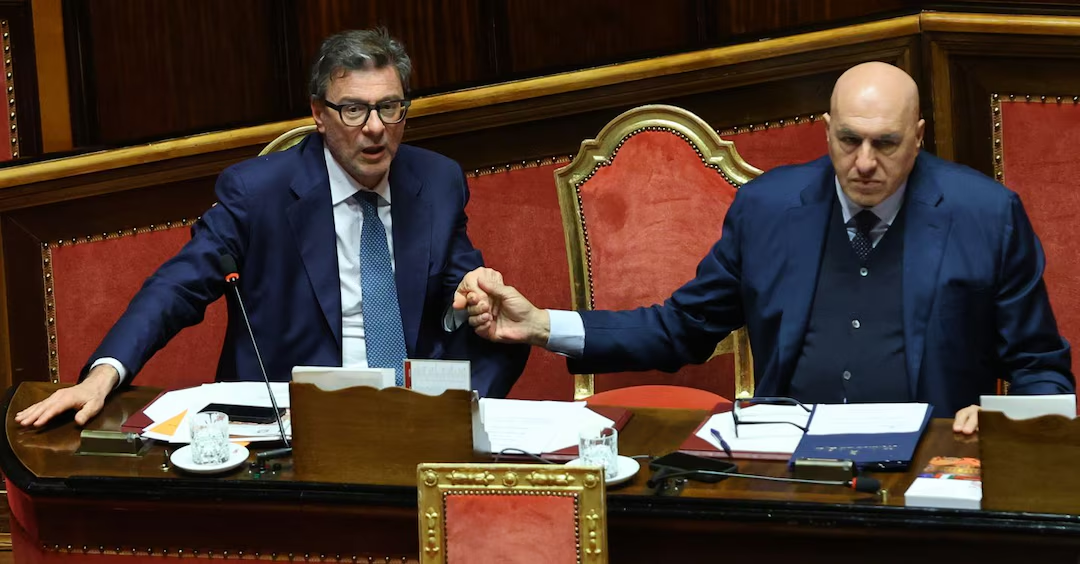
Crosetto at the EU Foreign Affairs Council (Defence), November 2022
CSDP History: From Maastricht to Lisbon
The Common Security and Defence Policy (CSDP) has roots in the Maastricht Treaty of 1992, which established the Common Foreign and Security Policy (CFSP) and referred to the possibility of a common defence. But the decisive impetus came from outside EU institutions: the Saint-Malo Declaration of December 1998, a Franco-British summit communiqué signed by Prime Minister Tony Blair and President Jacques Chirac, declared that the EU must have "the capacity for autonomous action, backed up by credible military forces." Saint-Malo was a strategic breakthrough — it was the moment the two largest European military powers agreed that the EU needed its own defence capacity.
The subsequent decade saw rapid institutional development: the creation of the Political and Security Committee (PSC), the EU Military Committee (EUMC), the EU Military Staff (EUMS), and the European Defence Agency (EDA). The EU launched its first military operation — Operation Concordia in Macedonia — in 2003, and its first naval mission in 2008. The Lisbon Treaty of 2009 gave the CSDP its current treaty basis in Articles 42 to 46 TEU, providing for the possibility of Permanent Structured Cooperation (PESCO) and creating the mutual defence clause at Article 42.7, which obliges member states to aid any member attacked, subject to the special character of certain members' security and defence policies.
The EU Global Strategy published in June 2016 by Foreign Policy Chief Federica Mogherini articulated a new level of EU ambition in defence, calling for "strategic autonomy" — the capacity to act independently when circumstances require — and prompted a new wave of institutional and industrial initiatives. The Strategy led directly to the creation of PESCO, the European Defence Fund, and the Coordinated Annual Review on Defence (CARD).
The relationship between CSDP and NATO has been managed through the "Berlin Plus" arrangements of 2003, which allow the EU to draw on NATO assets and capabilities for its own operations, and through political commitments to complementarity and no duplication. Italy has consistently been among the strongest advocates for ensuring that the EU-NATO relationship remains cooperative rather than competitive.
PESCO – Permanent Structured Cooperation
Permanent Structured Cooperation (PESCO) was established by Council Decision in December 2017, with 25 of the then 28 EU member states (all except Denmark, Malta, and the United Kingdom) joining as founding participants. Under PESCO, member states undertake binding commitments including regular real increases in defence budgets, increasing defence expenditure on R&D, participating in multinational capability development projects, and increasing the deployability and interoperability of their forces.
Italy was a founding PESCO participant and is among its most active members. Italy participates in a broad range of PESCO projects spanning different capability domains — including projects related to military mobility (improving the infrastructure to move forces across Europe), naval capabilities, cyber defence training, counter-drone systems, and logistics. Italian participation reflects both the breadth of Italy's defence industrial capacity and its interest in shaping the EU capability development agenda.
How PESCO works in practice: member states propose projects and, once a project is established, interested states commit to participation with binding obligations to contribute. Projects are reviewed every two years, and non-delivery can in principle lead to suspension of a participating state. The PESCO governance structure involves the Council, the PSC, the EUMC, and the EDA, which provides technical support to most projects. Over sixty PESCO projects have been launched across multiple capability domains since 2018.
PESCO's significance lies not only in the individual projects but in the principle of binding commitments: unlike earlier voluntary cooperation, PESCO creates institutional accountability for delivery, even if the accountability mechanisms have not yet been vigorously tested. For Italian defence industry, PESCO projects provide a framework for collaborative development that can sustain Italian technological capacity and market access within Europe.
European Defence Fund and EDIP
The European Defence Fund (EDF), launched in 2021 with a budget of approximately €7.9 billion for the 2021–2027 Multiannual Financial Framework period, represents the most significant use of EU budget resources for defence research and development in the Union's history. The EDF has two pillars: a research window funding basic and disruptive research, and a capability window funding collaborative development of defence equipment and technology. Participation in EDF projects requires collaboration between entities from at least three EU member states.
Italian defence companies and research institutions have been active and successful participants in EDF projects, reflecting Italy's strong defence industrial base. Leonardo, Italy's primary defence and aerospace company, has participated in multiple EDF projects in areas including electronics, avionics, and cyber. Fincantieri, the world-class Italian naval shipbuilder, has engaged in naval EDF projects. Iveco Defence Vehicles has participated in land systems projects. Beyond these prime contractors, Italy's university research institutes and smaller defence technology companies have also secured EDF funding.
The European Defence Industrial Programme (EDIP), agreed in 2024 as an interim measure ahead of a fuller instrument, focuses on strengthening European defence industrial capacity with particular urgency given the lessons of Ukraine — where the scale of ammunition and equipment consumption has revealed structural shortfalls in European production capacity. EDIP includes incentives for ammunition production acceleration and for joint procurement among member states. Italy supports EDIP as a mechanism to sustain and expand European industrial capacity, provided that it does not create bureaucratic constraints that disadvantage European producers relative to non-European suppliers.
European Defence Agency
The European Defence Agency (EDA), headquartered in Brussels, was established in 2004 to support EU member states in developing defence capabilities, facilitating collaborative research, supporting CSDP, and promoting the development of a competitive European defence technological and industrial base (EDTIB). Italy has been an active EDA participant since its founding, engaging across the Agency's work programmes.
Through the EDA, Italy has participated in collaborative projects in areas including helicopter training (the Helicopter Exercise Programme), maritime patrol aircraft capability development, military airworthiness standards, and unmanned aerial systems. Italy contributes to EDA's annual defence data collection, which provides the baseline for EU-wide assessment of capability development and defence investment trends. EDA's CARD (Coordinated Annual Review on Defence) process, in which Italy participates, aims to improve visibility among member states' defence planning and identify opportunities for collaboration before decisions are locked in national plans.
Italy's Position on EU Defence Integration
Italy's consistent position on EU defence integration is one of genuine support for deeper EU capability and institutional development, coupled with an equally consistent insistence that EU defence must complement — not replace or compete with — NATO as the primary framework for collective defence. Italy occupies a bridge position between two distinct camps within EU defence discussions: a "NATO-first" camp (led primarily by the newer member states of Central and Eastern Europe, who regard NATO and US commitment as indispensable to their security) and an "EU autonomy" camp (led primarily by France, which has most consistently argued for genuine European strategic independence from the US).
Italy's bridge position reflects its own strategic experience: as a founding member of both NATO and the EU, as a nation with deep Atlanticist convictions but also strong European federalist instincts, and as a major defence industrial nation with interests in both US and European programmes. Italy does not want to choose between Atlanticism and Europeanism in defence — it wants both, structured so that they reinforce each other.
In practical terms, this has meant Italy supporting PESCO, the EDF, and institutional development in CSDP, while consistently resisting formulations that would position EU defence as an alternative to NATO. Italy has been cautious about proposals — primarily French — that would create EU autonomous command structures that duplicate NATO's functions or that could lead to the decoupling of US commitment from European defence. The Italian line, maintained consistently under Crosetto, is that a stronger Europe within NATO is preferable to a stronger Europe outside or alongside NATO.
CSDP Missions and Operations
EUNAVFOR Atalanta (Horn of Africa / Indian Ocean): Launched in 2008 to counter piracy off the coast of Somalia, Atalanta is the EU's longest-running naval mission and one of its most successful. Italy has contributed naval units to Atalanta consistently, including frigates, patrol vessels, and maritime patrol aircraft. The mission has essentially suppressed the high-tempo piracy that characterised the Somali basin in 2008–2012, though it maintains a residual deterrent posture.
EUNAVFOR MED Operation Irini (Mediterranean, Libya): Launched in March 2020, Irini implements the UN Security Council arms embargo on Libya through naval and aerial surveillance of vessels in the Mediterranean. Irini has its operational headquarters in Rome — a deliberate recognition of Italy's central interest in Libyan stability and its Mediterranean role. Italy has contributed naval and aerial assets to the mission and has been among its most committed supporters. The mission also monitors illegal oil exports from Libya and disrupts human trafficking networks when they coincide with embargo enforcement.
EUTM Somalia (European Union Training Mission Somalia): Italy has contributed to the EU training mission in Somalia, which supports the capacity building of Somali National Army forces. The mission is part of the broader international effort to support the Somali Federal Government against Al-Shabaab.
EUTM Mali / Sahel transitions: Italy contributed to the European Union Training Mission in Mali, which built capacity for the Malian Armed Forces. The mission's suspension following the military coup in Mali and the political deterioration of the EU's Sahel engagement has been a significant setback for the EU's CSDP ambitions in Africa, and Italy has been engaged in discussions about how to reconfigure EU engagement in the region.
Across these missions, Italy has served in both contributing and framework nation roles, demonstrating both operational commitment and institutional leadership within the CSDP framework.
Crosetto's Position on European Defence
Crosetto approaches European defence from a distinctive vantage point: he is both a committed Atlanticist and a genuine European integrationist in the defence domain. His background in the defence industry — as founder and president of AIAD, the Italian federation of aerospace, defence, and security companies — gives him direct knowledge of the industrial dimension that most ministers approach primarily through a security policy lens. He understands what PESCO and EDF mean for Italian companies, for employment, and for Italy's capacity to maintain genuine defence technological sovereignty.
His consistent position has been that EU defence must be built as a genuine capability — not as a political statement. PESCO projects should produce real interoperability. The EDF should fund genuinely collaborative R&D that moves European technology forward, not merely launder national programmes through EU branding. CSDP missions should have clear mandates, adequate resources, and realistic assessments of what they can achieve.
He has also been clear that EU-NATO cooperation is not zero-sum. Italy's contributions to CSDP missions do not substitute for its NATO contributions; they add to the overall pool of stabilisation, deterrence, and security capacity that Italy brings to its alliance commitments. The two are complementary: NATO handles collective defence; CSDP handles crisis management, stabilisation, and capacity building where NATO as an institution is not the right vehicle. Italy's interest is in making both work well, not in choosing between them.
The Strategic Autonomy Debate
The debate over "European strategic autonomy" has been one of the defining tensions in EU defence policy since French President Emmanuel Macron dramatically elevated the concept in a 2019 interview where he declared NATO "brain dead." Macron's argument — that Europe cannot rely indefinitely on US commitment and must develop the capacity to defend itself independently — has resonated in some European capitals but generated significant resistance in others, particularly among Central and Eastern European states that regard US commitment as essential and distrust any formulation that might weaken it.
Germany has been broadly cautious about strategic autonomy rhetoric that risks undermining transatlantic solidarity, though it has supported practical EU defence cooperation. The larger Central European states — Poland above all — have been explicitly critical of strategic autonomy framing, arguing that Europe's security depends on NATO and the US presence, not on EU institutional development.
Italy's position has been one of nuanced balance. Italy shares France's general view that Europe needs to invest more in its own defence and cannot remain as dependent as it has been on the US for its security. But Italy diverges from the French position on the institutional conclusion: where France has at times implied that EU autonomy requires distance from NATO, Italy maintains that EU capability-building and NATO commitment are fully compatible and mutually reinforcing. Italy has been particularly resistant to any suggestion that EU defence should be structured to function without or in parallel to NATO — a structure that would risk unravelling the transatlantic relationship that Italy regards as fundamental.
In practical terms, Crosetto has supported substantial EU defence investment while resisting institutional overreach: stronger European industry, more capable CSDP missions, deeper research collaboration — yes. Rival command structures, duplicative planning processes, or rhetoric that casts US alliance commitments as problematic — no. This is the Italian formula, and it has remained consistent under Crosetto.
GCAP and the EU: Post-Brexit Complexity
The Global Combat Air Programme (GCAP) — Italy's flagship next-generation military aviation commitment — sits in an interesting relationship with EU defence frameworks. GCAP is a trilateral programme with the United Kingdom and Japan, neither of which are EU member states. The UK left the EU in January 2020; Japan has never been part of the European integration project. This means GCAP cannot benefit from EDF funding or be structured as a PESCO project, and it involves the deepest industrial collaboration with a non-EU partner (the UK) at a time when the post-Brexit relationship between the UK and EU in defence remains complex.
Leonardo serves as Italy's industrial anchor in GCAP alongside BAE Systems (UK) and Mitsubishi Heavy Industries (Japan). From a purely industrial perspective, GCAP represents a significant commitment of Leonardo's engineering capacity and future revenue expectations to a non-EU programme. This does not conflict with Leonardo's participation in EU programmes — the company maintains an active portfolio of EDF-funded projects — but it does mean that Italy's most prestigious defence technology programme operates outside the EU framework.
Italian officials, including Crosetto, have been careful to frame GCAP as complementing rather than competing with EU defence ambitions. The aircraft will serve in the Italian Air Force well into the second half of the century, providing the capability foundation for Italy's contribution to both NATO collective defence and CSDP operations. The question of whether a future GCAP aircraft could be exported to EU partners — potentially bridging the EU-UK divide in military aviation — remains a long-term possibility, but one dependent on export control agreements, workshare arrangements, and political decisions that lie many years away.
The broader lesson of GCAP for EU defence is instructive: in a world of complex alliance relationships, not all of Europe's most important defence collaborations will fit neatly within EU frameworks. Italy's approach has been to pursue the most capable partnerships available — whether through EU mechanisms, NATO, or bespoke arrangements like GCAP — while ensuring they collectively serve Italian and European security interests.